
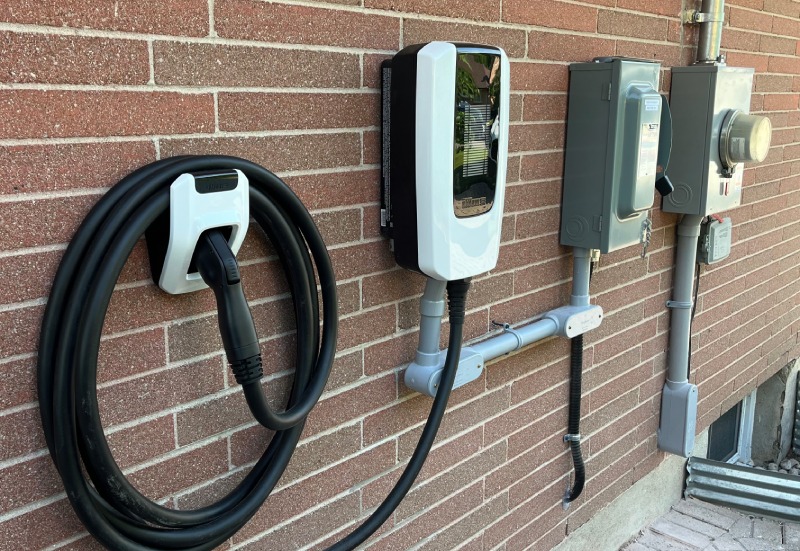
EV charger installation costs in London, Ontario depend on the charger, circuit routing, permit and inspection requirements, labour, and any panel or service work your home needs. Level 2 EV charger installation refers to the electrical work required to safely connect a home charging unit at the parking location. A site assessment is the most reliable way to set the final price.
KEY TAKEAWAYS
- An EV charger quote should clearly state whether the charging unit is included or supplied by the homeowner.
- The route from the electrical panel to the parking spot can change material use and labour more than the charger itself.
- Panel or service work can add cost when the existing electrical system cannot support the new charging load.
- Detached garages and outdoor parking locations can require routing, trenching, exterior protection, and access work.
- A fixed quote should identify permits, inspections, exclusions, and the process for approving any legitimate scope change.
The Cost Components: Charger, Circuit, Permit, Labour
The final number is built from four main buckets: charger hardware, the new charging circuit, ESA notification and inspection, and labour. A complete quote includes all of the items discussed, so you know exactly what is included in the work.
The charger unit may be supplied by you or provided by the contractor. That detail matters because two quotes can look very different when only one includes the hardware. The quote should name the charger or state that the unit is customer-supplied.
- Charger: the home charging unit, mounting hardware, and any supplied accessories listed in the scope.
- Circuit: breaker, conductors, conduit or cable, fittings, and materials needed to reach the parking location.
- Permit and inspection: ESA notification and inspection costs, shown as included or excluded before work begins.
- Labour: route planning, installation, mounting, termination, testing, labelling, cleanup, and project coordination.
Sandiparks offers a dedicated EV charger installation service for homeowners across London and Southwestern Ontario. A site review confirms the scope before a final quote is provided.
This is where fair pricing starts. A low number is not automatically a better price if the quote omits equipment, inspection, or necessary electrical work. Sandiparks is built on clear pricing and no surprise invoices. The scope should make sense before anyone starts.
Distance From Panel to Parking Spot, and Why It Matters Most
Distance matters because every additional section of route adds material and installation time, but route difficulty matters just as much as straight-line distance. The electrician needs to see how the circuit can travel from the panel to the actual parking position.
A panel beside an attached garage can provide a straightforward route. A panel on the opposite side of a finished basement may require more planning, drilling, protection, and labour. A short route through difficult finished areas can take more time than a longer route through open utility space.
The quote should outline the planned path, not just the approximate distance. That path may pass through unfinished basement space, a utility room, an exterior wall, an attic, or another accessible route. Each home is different, so a phone estimate cannot replace an on-site assessment for a firm price.
If you are still deciding on the charger location, choose the parking spot you will use every day. Moving the unit later can create another electrical project. Planning the route once helps keep the installation practical in the long term.
Panel Capacity Work That Can Be Triggered by the Installation
Panel capacity work can increase the installation cost when the existing electrical system cannot safely support the added charging load. The electrician checks available capacity before treating an open breaker position as proof that the charger will fit.
A load calculation assesses the electrical demand already on the home and the additional demand the charger will add. A panel may have physical space for another breaker yet still lack sufficient service capacity for the new load.
If the existing system has enough capacity, the project can stay focused on the charger circuit. If it does not, the scope may expand to panel or service work before charging can be added safely. That is one reason two otherwise similar homes can receive very different installation quotes.
When capacity work is required, Sandiparks can assess panel upgrades and replacements as part of the broader electrical plan. The goal is to address the actual capacity issue, not simply add equipment because a panel looks crowded.
Service work can also involve coordination outside the home. If the project changes the incoming service or metering arrangement, utility requirements can affect the schedule and total cost. A clear quote should identify that possibility before you sign.
Detached Garage and Outdoor Runs
Detached garages and outdoor parking spots often require more routing work because the charging circuit may run outside the house or underground. The final price depends on the actual path, access, surface conditions, and the level of protection the installation requires.
A detached garage may already have electrical service, but that does not automatically mean it can support an EV charger. The electrician still needs to confirm the existing electrical supply, panel capacity, and the route to the charging location.
- Trenching or underground routing when the circuit must cross a yard, driveway edge, or other exterior area.
- Exterior conduit, fittings, penetrations, and mounting work where the circuit leaves one building and enters another.
- Access limitations around finished landscaping, concrete, storage, or existing structures that affect the route.
- Restoration responsibilities, including whether trench backfill or surface repair is included in the electrical scope.
Outdoor installations also need a location that works for the vehicle and for daily cable use. The best position is practical, protected, and reachable without creating a trip hazard or causing constant cable strain. These details are easier to resolve before materials are ordered.
For more homeowner context before booking, review EV Charger Installation: What Ontario Homeowners Need to Know. It serves as a helpful companion to a site-specific installation quote.
What a Fixed Quote Should Include Before You Sign
A fixed quote should clearly state what is included, what is excluded, and what could legitimately change the price before work starts. That makes the quote useful for comparing contractors and planning the project.
- The charger model or a clear note stating that the charging unit is customer-supplied.
- The new circuit scope, including the planned route and the charger mounting location.
- ESA notification and inspection are included in the quote, so you know they are covered.
- Any panel, service, or capacity work already identified during the assessment.
- Trenching, drilling, exterior routing, and restoration work that is included or excluded.
- Utility coordination if service changes are required before the charger can be connected.
- Testing, labelling, cleanup, and the process to follow if hidden conditions change the approved scope.
The quote should also outline its assumptions. For example, a route may be priced on the assumption that an accessible pathway is available. If a concealed condition changes that route, the contractor should stop, explain the issue, and obtain your approval before proceeding with the work.
Credentials matter in the decision as well. Sandiparks Electrical is ECRA registered and led by a Master Electrician. Ryan earned his Master Electrician licence in 2020.
If you want a project-specific number, request a quote. A clear assessment is the fastest way to turn a broad cost question into a scope you can rely on.
Conclusion
The best EV charger installation quote is not the one with the fewest line items. It is the one that clearly outlines the complete scope, the actual site conditions, and the approvals required to do the work safely. That approach reflects how Sandiparks works: honest trades done right, with clear communication before the job begins. If you are planning Level 2 charging in London or Southwestern Ontario, request a site-specific quote so you know the final cost before installation day.
Frequently Asked Questions
Is the charger unit included in an installation quote?
Not always. Some EV charger installation quotes include the charging unit, while others quote only the electrical work and assume you will supply the charger. The written quote should specify which approach applies, name the unit if included, and identify any accessories or mounting hardware that are part of the scope.
Why do EV charger quotes vary so widely?
EV charger quotes vary because the electrical scope can differ significantly from one home to another. Panel capacity, circuit length, route difficulty, outdoor or detached-garage work, permit and inspection costs, and charger supply can all affect the total. Compare what each quote includes before comparing the final numbers.
Does an EV charger install always require a permit?
Yes, a Level 2 EV charger installation in Ontario requires the applicable ESA notification and inspection process. The contractor should identify that requirement in the quote and explain whether the related fee is included. Proper notification creates a documented inspection path and supports code-compliant work rather than an unreported installation.
Can the install be done in one visit?
Sometimes. A straightforward installation can often be completed in a single scheduled visit when panel capacity is confirmed, the route is accessible, and no service upgrade or utility coordination is required. More complex projects may require an assessment visit, additional electrical work, or separate scheduling before the charger can be placed into service.